Stoner rock · doom · sludge · heavy alt-rock
C Standard Tuning (C F Bb Eb G C) — Chords & Fretboard
The fretboard is tuned two whole steps down: C–F–Bb–Eb–G–C. Standard shapes still work but sound a major third lower, so an open E shape is a huge C chord. The chord finder below names every shape correctly for C standard; below are the shape map, tuning steps and — most important — the heavier strings this tuning needs.
- C–F–Bb–Eb–G–C
- All standard shapes work
- Sounds two whole steps lower
- Needs .012–.056 or heavier
Fretboard & chord finder
Pick a tuning and key, click any fret to hear it, and see every scale tone and chord degree across the neck.
Scale & Arpeggio Neck Boxes Show / Hide ▾
Chord voicings
Every playable voicing of each chord in the current key, ranked V1–Vn up the neck. Filter by difficulty or chord type, and use ← → on a card to step through its voicings.
Progression looper & tab
Queue chords, choose a picking pattern and meter, loop it, then export tab, MIDI or a printable chord sheet.
String tension calculator
Total: 103.8 lbs • Avg: 17.3 lbs • All Strings Safe (Balanced) • Custom .010–.046
| Str | Pitch | Scale | Gauge | Tension | Status |
|---|
Guitar tuner
Tune with your microphone to any preset or custom tuning, or tap a string to hear its reference pitch.
Odd-time drum machine
Program custom odd-meter drum grooves in 4/4, 5/4, 6/8, 7/8, 9/8, or 11/8, or enable Sync with Chord Looper so the kit plays behind your chord progressions.
Chord identifier & capo transposer
Tap frets on the neck below or type any 6-string fret grip (like 0-5-3-0-0-0 or X-3-2-0-1-0) to identify every possible chord name, interval formula, and capo equivalent.
Capo & Alternate-Tuning Transposer Equivalents
See how to play this exact concert chord using different capo positions or alternate tunings.
Fretboard & ear trainer
Master note locations across unfamiliar tunings (FACGCE, DAEAC#E, DADGAD, Standard), sharpen interval ear recognition, drill scale degrees, and spell complex chord formulas.
When practicing in alternate tunings such as FACGCE or DAEAC#E, the trainer dynamically recalculates fretboard intervals, open drone strings, and chord voicings so you build genuine muscle memory.
C standard tuning explained
C standard lowers every string by two whole steps (four semitones): C–F–Bb–Eb–G–C. As with Eb and D standard, the intervals between strings are untouched, so every chord shape and scale pattern you know still works — it just sounds a major third lower and much heavier. The open "E shape" is now a C chord, the "A shape" is F, the "D shape" is Bb and the "G shape" is Eb.
It is the classic stoner and doom tuning: Queens of the Stone Age wrote their early records in it (including "No One Knows" and "A Song for the Dead" on Songs for the Deaf), and bands such as Sleep and Kyuss built their wall-of-fuzz sound around it. Because the low string is a C, riffs sit in the same register as a 7-string's low end while keeping six-string fingerings.
C standard vs Drop C
Drop C (C–G–C–F–A–D) has the same lowest note, but only its 6th string is dropped further than the rest — strings 5–1 are a whole step down. C standard lowers everything by the same amount, so chord shapes stay "standard", whereas Drop C gives you one-finger power chords. If you play riffs with lots of power chords, compare both on the Drop C page.
How to tune to C standard
- Lower each string four semitones: E → C, A → F, D → Bb, G → Eb, B → G, E → C.
- Tune the 6th string first, then use the normal 5th-fret / 4th-fret reference method between neighbouring strings.
- Do two full passes — the neck relaxes noticeably when all six strings drop this far.
Strings are not optional here. Four semitones down cuts tension by about 37%: a .010–.046 set is unplayably slack, and even .011s feel loose. The usual starting points are .012–.056, .013–.056 or .012–.060 on a 25.5" scale; many stoner players use .013–.062. On a 24.75" scale go heavier again, and expect to widen the nut slots and reset the truss rod. Use the tension calculator to match the feel of your standard-tuning set.
Essential C standard chord shapes
⬇ Printable C standard chord chart (PDF)Diagrams show strings low to high (6 → 1, left to right). × = don't play that string, ○ = open string, orange = the root note. Every shape was checked note-by-note against the tuning. Press Play to load it on the fretboard above and hear it.
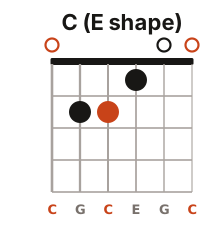
The open E shape is now a massive C major.
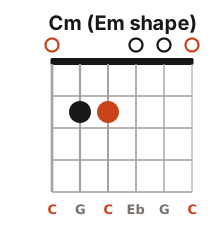
Open Em shape → C minor.
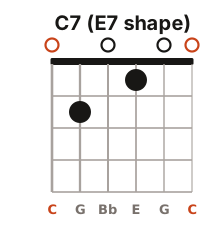
Open E7 shape → C7.
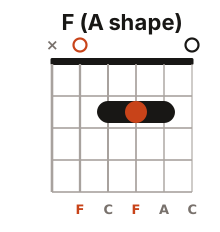
Open A shape → F major.
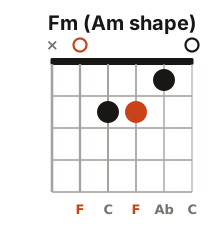
Open Am shape → F minor.
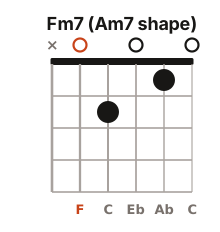
Open Am7 shape → Fm7.
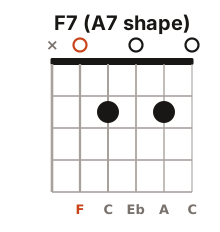
Open A7 shape → F7.
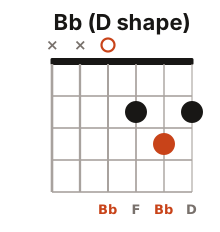
Open D shape → Bb major.
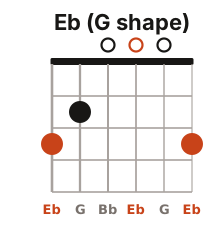
Open G shape → Eb major.
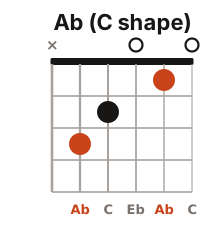
Open C shape → Ab major.
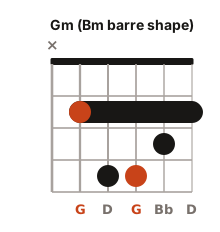
Bm barre at fret 2 → G minor.
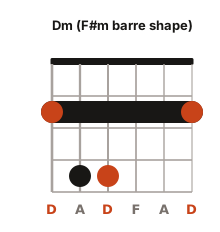
F#m barre at fret 2 → D minor.
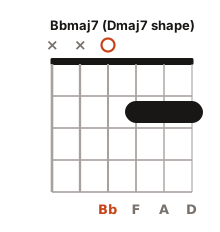
Dmaj7 shape → Bbmaj7.
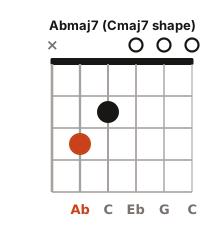
Cmaj7 shape → Abmaj7.
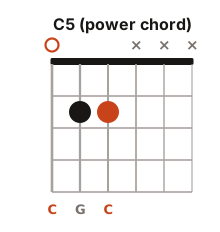
Open E5 power chord → C5.
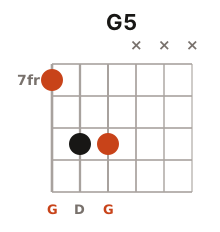
Root-on-6th power chord at fret 7 → G5.
Suggested starting point on a 25.5" scale: .012–.056 or .013–.056 (25.5"); .012–.060+ on 24.75". Run your own gauges through the tension lab before you buy.
Frequently asked questions
What gauge strings do I need for C standard?▾
At least .012–.056 on a 25.5" scale; .013–.056 or .012–.060 if you pick hard, and heavier still on a 24.75" scale. A standard .010–.046 set loses about 37% of its tension four semitones down and will buzz, intonate sharp and go out of tune when you hit it.
Is C standard the same as Drop C?▾
No. Drop C is C–G–C–F–A–D: strings 5–1 are a whole step down and only the 6th string goes down two whole steps. C standard is C–F–Bb–Eb–G–C: every string goes down two whole steps, so standard chord shapes keep working.
Which songs are in C standard?▾
Queens of the Stone Age's early albums are largely in C standard, including "No One Knows" and "A Song for the Dead"; Sleep's "The Botanist" and Kyuss's "Asteroid" are other well-known examples, and the tuning is everywhere in doom and sludge.
Will C standard damage my guitar?▾
No — lowering tension never harms a guitar. The setup will change, though: with heavier strings you may need wider nut slots, a truss-rod adjustment and new intonation. Keep a guitar set up for C standard rather than retuning one guitar back and forth.
Related tools & tunings
Found a mistake or want a tuning covered? Leave a note on Ko-fi. Last updated 2026-10-28.