Slide · folk · blues · Joni Mitchell / Dylan tuning
Open D Tuning Chords & Fretboard (DADF#AD)
The fretboard is in Open D. Every open string belongs to a D major chord, a one-finger barre is a major chord anywhere on the neck, and a single fretted note turns the open chord into sus4, minor, 7th or add9. Pick any chord below for voicings, or scroll for the shapes, slide positions and tuning steps.
- D–A–D–F#–A–D
- Open strings = D major
- Barre any fret = major chord
- Three strings down
Fretboard & chord finder
Pick a tuning and key, click any fret to hear it, and see every scale tone and chord degree across the neck.
Scale & Arpeggio Neck Boxes Show / Hide ▾
Chord voicings
Every playable voicing of each chord in the current key, ranked V1–Vn up the neck. Filter by difficulty or chord type, and use ← → on a card to step through its voicings.
Progression looper & tab
Queue chords, choose a picking pattern and meter, loop it, then export tab, MIDI or a printable chord sheet.
String tension calculator
Total: 103.8 lbs • Avg: 17.3 lbs • All Strings Safe (Balanced) • Custom .010–.046
| Str | Pitch | Scale | Gauge | Tension | Status |
|---|
Guitar tuner
Tune with your microphone to any preset or custom tuning, or tap a string to hear its reference pitch.
Odd-time drum machine
Program custom odd-meter drum grooves in 4/4, 5/4, 6/8, 7/8, 9/8, or 11/8, or enable Sync with Chord Looper so the kit plays behind your chord progressions.
Chord identifier & capo transposer
Tap frets on the neck below or type any 6-string fret grip (like 0-5-3-0-0-0 or X-3-2-0-1-0) to identify every possible chord name, interval formula, and capo equivalent.
Capo & Alternate-Tuning Transposer Equivalents
See how to play this exact concert chord using different capo positions or alternate tunings.
Fretboard & ear trainer
Master note locations across unfamiliar tunings (FACGCE, DAEAC#E, DADGAD, Standard), sharpen interval ear recognition, drill scale degrees, and spell complex chord formulas.
When practicing in alternate tunings such as FACGCE or DAEAC#E, the trainer dynamically recalculates fretboard intervals, open drone strings, and chord voicings so you build genuine muscle memory.
Open D tuning explained
Open D tunes the guitar to a D major chord: D–A–D–F#–A–D. Because the open strings already spell the chord, a straight barre (or a slide) across any fret gives you a major chord — fret 5 is G, fret 7 is A — which is why it is the home tuning of Delta and electric slide (Elmore James, Duane Allman in its sibling Open E) and of a huge body of folk and singer-songwriter music. Joni Mitchell wrote in it constantly, and Bob Dylan recorded the original Blood on the Tracks sessions in it.
The 3rd string carries the major third (F#), so the colour of the whole chord lives on one string: lower it a fret (F) for minor, raise it a fret (G) for sus4, or leave it off. Melodies on the top two strings (A–D) run in fourths, which suits pull-off-heavy folk picking. Open D is Open E lowered a whole step; the shapes are identical and the tension is kinder.
How to tune to Open D from standard
- 6th string: E → D (down a whole step).
- 5th string: A — unchanged.
- 4th string: D — unchanged.
- 3rd string: G → F# (down a half step).
- 2nd string: B → A (down a whole step).
- 1st string: E → D (down a whole step).
All four changes go down, so a standard set works; slide players usually prefer .012–.054 or .013–.056 and a higher action so the slide doesn't clatter on the frets. Compare sets in the tension calculator.
Slide positions in Open D
With a straight bar: fret 0 = D, 3 = F, 5 = G, 7 = A, 10 = C, 12 = D. A classic blues in D is bars at 0, 5 and 7; the "sweet" notes above a barre chord are two frets up on the 1st string (the 9th) and three frets up on the 2nd string (the minor 7th).
Essential DADF#AD chord shapes
⬇ Printable DADF#AD chord chart (PDF)Diagrams show strings low to high (6 → 1, left to right). × = don't play that string, ○ = open string, orange = the root note. Every shape was checked note-by-note against the tuning. Press Play to load it on the fretboard above and hear it.
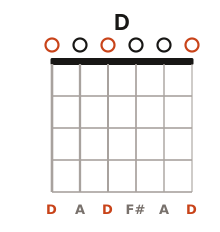
Open strings — D major.
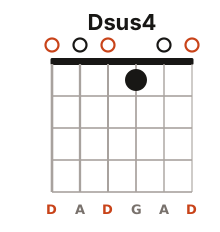
Raise the 3rd string one fret (G) for the classic open-tuning sus4 "hammer".
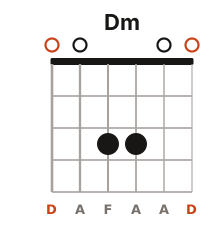
F on the 4th and 3rd strings turn the chord minor.
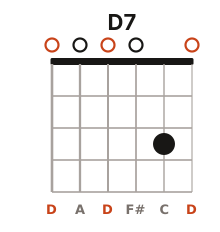
C at fret 3 on the 2nd string for a dominant 7th.
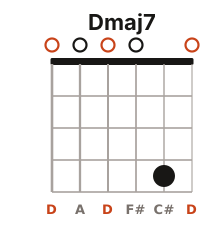
C# at fret 4 on the 2nd string.
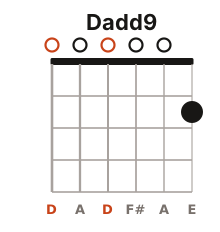
E on the 1st string — the sweet "9th above the barre" sound.
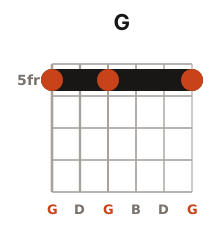
Straight barre at fret 5 (slide position).
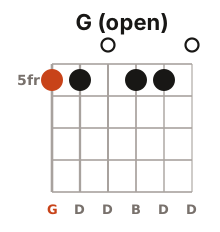
G major with open D strings ringing — no barre needed.
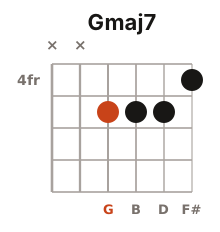
Gmaj7 on the top four strings.
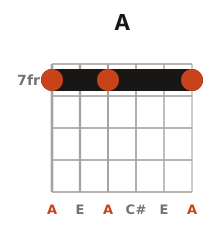
Straight barre at fret 7.
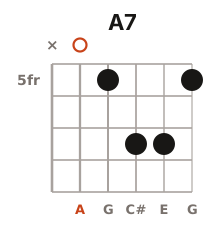
A7 using the open A string as the root.
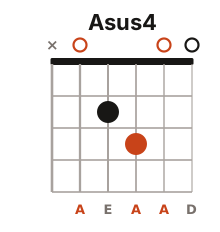
Asus4 with open 2nd and 1st strings.
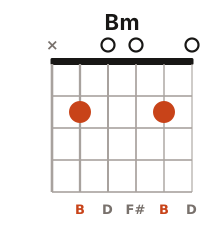
The relative minor, two fingers.
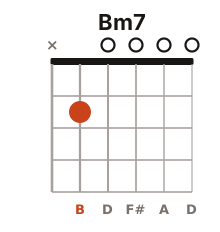
One finger at fret 2 on the 5th string.
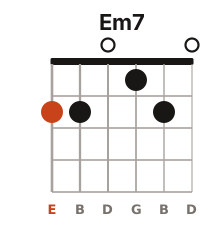
The ii chord with a big open-string ring.
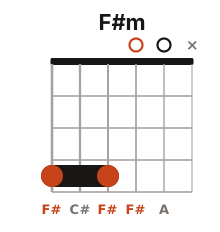
The iii chord; mute the high D.
Suggested starting point on a 25.5" scale: .011–.052 electric / .012–.054 acoustic (heavier for slide). Run your own gauges through the tension lab before you buy.
Frequently asked questions
What is the difference between Open D and DADGAD?▾
Only the 3rd string: Open D has F# (a major third), DADGAD has G (a fourth). Open D sounds a complete D major chord; DADGAD sounds a Dsus4 and is modally ambiguous. Everything else about the tunings is identical, so you can switch between them by moving one string a half step.
Open D or Open E — which should I use?▾
They are the same tuning a whole step apart. Open D lowers three strings from standard (gentle on the neck and strings); Open E raises three strings (A→B, D→E, G→G#), adding significant tension. Many players tune to Open D and capo at fret 2 when they need Open E.
What songs are in Open D?▾
Joni Mitchell's "Big Yellow Taxi" (Open E, same shapes), Bob Dylan's "Simple Twist of Fate" and other Blood on the Tracks songs, Bruce Cockburn's and Pierre Bensusan's repertoire, and most slide blues from Elmore James to the Black Keys.
Which string gauges suit Open D?▾
Any standard set works because every change goes down. For slide, heavier strings (.012–.054 acoustic, .011–.050 electric) and higher action give a cleaner tone. Use the tension calculator to see how much each string relaxes.
Related tools & tunings
Found a mistake or want a tuning covered? Leave a note on Ko-fi. Last updated 2026-10-28.