Bentonia blues · Skip James · minor-key slide
Open D Minor Tuning Chords & Fretboard (DADFAD)
The fretboard is in Open D minor: D–A–D–F–A–D. Every open string belongs to a D minor chord, a straight barre is a minor chord at any fret, and raising the 3rd string one fret flips the whole guitar to major — the "cross-note" sound of Skip James. Pick any chord below for voicings, or scroll for the shapes, slide positions and tuning steps.
- D–A–D–F–A–D
- Open strings = D minor
- Barre any fret = minor chord
- "Cross-note" / Bentonia tuning
Fretboard & chord finder
Pick a tuning and key, click any fret to hear it, and see every scale tone and chord degree across the neck.
Scale & Arpeggio Neck Boxes Show / Hide ▾
Chord voicings
Every playable voicing of each chord in the current key, ranked V1–Vn up the neck. Filter by difficulty or chord type, and use ← → on a card to step through its voicings.
Progression looper & tab
Queue chords, choose a picking pattern and meter, loop it, then export tab, MIDI or a printable chord sheet.
String tension calculator
Total: 103.8 lbs • Avg: 17.3 lbs • All Strings Safe (Balanced) • Custom .010–.046
| Str | Pitch | Scale | Gauge | Tension | Status |
|---|
Guitar tuner
Tune with your microphone to any preset or custom tuning, or tap a string to hear its reference pitch.
Odd-time drum machine
Program custom odd-meter drum grooves in 4/4, 5/4, 6/8, 7/8, 9/8, or 11/8, or enable Sync with Chord Looper so the kit plays behind your chord progressions.
Chord identifier & capo transposer
Tap frets on the neck below or type any 6-string fret grip (like 0-5-3-0-0-0 or X-3-2-0-1-0) to identify every possible chord name, interval formula, and capo equivalent.
Capo & Alternate-Tuning Transposer Equivalents
See how to play this exact concert chord using different capo positions or alternate tunings.
Fretboard & ear trainer
Master note locations across unfamiliar tunings (FACGCE, DAEAC#E, DADGAD, Standard), sharpen interval ear recognition, drill scale degrees, and spell complex chord formulas.
When practicing in alternate tunings such as FACGCE or DAEAC#E, the trainer dynamically recalculates fretboard intervals, open drone strings, and chord voicings so you build genuine muscle memory.
Open D minor tuning explained
Open D minor tunes the guitar to a D minor chord: D–A–D–F–A–D. It is Open D with the 3rd string lowered one more semitone, from F# to F — a one-string change that turns a bright major tuning into a dark, haunting one. Because the minor third lives only on the 3rd string, fretting that string at 1 gives you D major again; blues players call this a cross-note tuning, "where the major crosses the minor".
It is above all the tuning of Skip James and the Bentonia school of Mississippi blues — "Devil Got My Woman" and "Cherry Ball Blues" are the classic examples, and Robert Johnson's "Hell Hound on My Trail" borrows from that style. It has since been used by fingerstylists such as John Fahey and Martin Simpson for slow, droning minor-key pieces, and by slide players who want a minor chord under the bar.
How to tune to Open D minor from standard
- 6th string: E → D (down a whole step).
- 5th and 4th strings: A, D — unchanged.
- 3rd string: G → F (down a whole step).
- 2nd string: B → A (down a whole step).
- 1st string: E → D (down a whole step).
From Open D, just lower the 3rd string a half step (F# → F). Every change goes down, so any standard set works; slide players often prefer .011s or .012s and slightly higher action. See the tension calculator.
Slide positions
A straight bar gives minor chords: Dm (open), Fm (3), Gm (5), Am (7), Cm (10), Dm (12). For a major chord under the slide, angle or fret the 3rd string one fret higher than the bar — or play only strings 6, 5, 4, 2 and 1, which have no third at all and sound as power chords.
Essential DADFAD chord shapes
⬇ Printable DADFAD chord chart (PDF)Diagrams show strings low to high (6 → 1, left to right). × = don't play that string, ○ = open string, orange = the root note. Every shape was checked note-by-note against the tuning. Press Play to load it on the fretboard above and hear it.
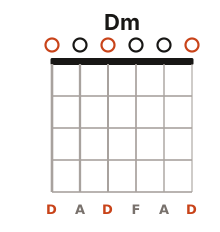
Open strings — D minor.
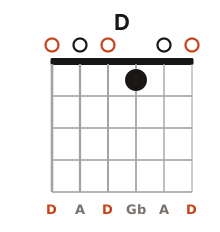
Raise the 3rd string one fret to F#: the "cross-note" switch to major.
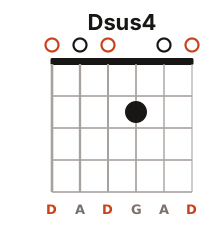
G on the 3rd string for Dsus4.
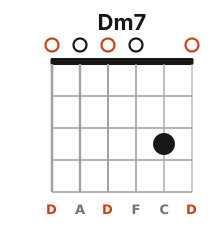
C on the 2nd string for Dm7.
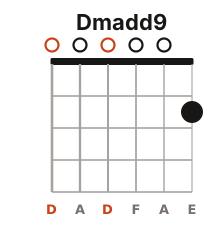
E on the 1st string — a dark, open Dm(add9).
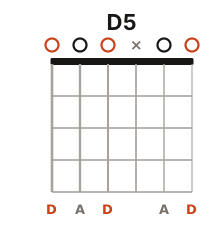
Mute the 3rd string: no third, pure drone.
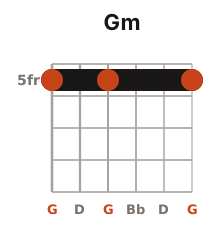
Straight barre at fret 5 — the iv chord.
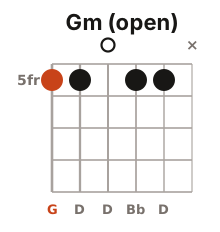
Gm with the open D ringing inside.
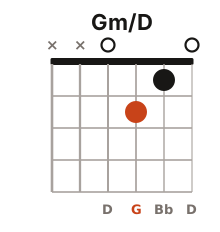
A small Gm over the open D.
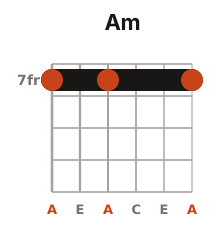
Straight barre at fret 7 — the minor v chord.
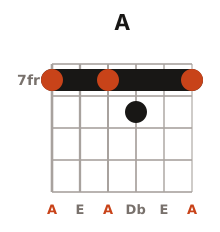
Barre at 7 with the 3rd string one fret higher: the major V chord.
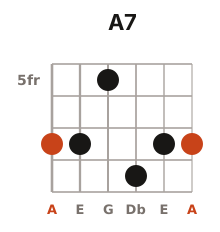
A7 for a stronger pull back to D minor.
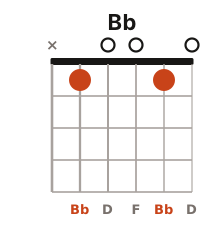
Two fingers at fret 1 — the bVI chord.
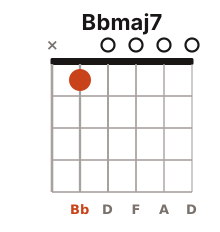
One finger: Bbmaj7, a beautiful colour against D minor.
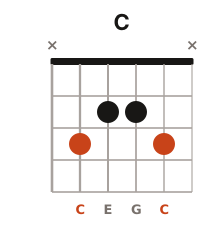
The bVII chord for Aeolian progressions (Dm – C – Bb).
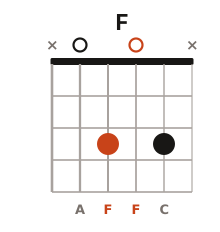
The relative major, with A in the bass.
Suggested starting point on a 25.5" scale: .010–.046 or .011–.050 electric / .012–.053 acoustic. Run your own gauges through the tension lab before you buy.
Frequently asked questions
What is the difference between Open D and Open D minor?▾
Only the 3rd string: Open D has F# (major third), Open D minor has F (minor third). Retune that one string a half step to switch between them, or fret it at 1 in Open D minor to play major chords.
What songs are in Open D minor?▾
Skip James' "Devil Got My Woman" and "Cherry Ball Blues" are the best-known examples of the Bentonia "cross-note" sound (James often tuned the same intervals to E minor or a semitone lower). The tuning also appears in pieces by John Fahey and Martin Simpson.
Why is it called cross-note tuning?▾
Skip James used the term for open minor tunings where one fretted note "crosses" the chord from minor to major. In DADFAD that note is the 3rd string at fret 1 (F → F#).
Can I play slide in Open D minor?▾
Yes. A straight bar gives a minor chord at every fret (Gm at 5, Am at 7), which suits slow, dark blues. For a major chord, leave out or angle past the 3rd string.
Related tools & tunings
Found a mistake or want a tuning covered? Leave a note on Ko-fi. Last updated 2026-10-28.