Devin Townsend · John Butler · drone & slide
Open C Tuning Chords & Fretboard (CGCGCE)
The fretboard is in Open C. The open strings are a huge, five-octave C major chord; a barre at any fret is a major chord and the single E string carries the third, so one finger flips major to minor or sus. Pick any chord below for voicings, then read the shapes and the low-C gauge advice.
- C–G–C–G–C–E
- Open strings = C major
- Barre any fret = major
- Low C needs a heavy 6th string
Fretboard & chord finder
Pick a tuning and key, click any fret to hear it, and see every scale tone and chord degree across the neck.
Scale & Arpeggio Neck Boxes Show / Hide ▾
Chord voicings
Every playable voicing of each chord in the current key, ranked V1–Vn up the neck. Filter by difficulty or chord type, and use ← → on a card to step through its voicings.
Progression looper & tab
Queue chords, choose a picking pattern and meter, loop it, then export tab, MIDI or a printable chord sheet.
String tension calculator
Total: 103.8 lbs • Avg: 17.3 lbs • All Strings Safe (Balanced) • Custom .010–.046
| Str | Pitch | Scale | Gauge | Tension | Status |
|---|
Guitar tuner
Tune with your microphone to any preset or custom tuning, or tap a string to hear its reference pitch.
Odd-time drum machine
Program custom odd-meter drum grooves in 4/4, 5/4, 6/8, 7/8, 9/8, or 11/8, or enable Sync with Chord Looper so the kit plays behind your chord progressions.
Chord identifier & capo transposer
Tap frets on the neck below or type any 6-string fret grip (like 0-5-3-0-0-0 or X-3-2-0-1-0) to identify every possible chord name, interval formula, and capo equivalent.
Capo & Alternate-Tuning Transposer Equivalents
See how to play this exact concert chord using different capo positions or alternate tunings.
Fretboard & ear trainer
Master note locations across unfamiliar tunings (FACGCE, DAEAC#E, DADGAD, Standard), sharpen interval ear recognition, drill scale degrees, and spell complex chord formulas.
When practicing in alternate tunings such as FACGCE or DAEAC#E, the trainer dynamically recalculates fretboard intervals, open drone strings, and chord voicings so you build genuine muscle memory.
Open C tuning explained
Open C — C–G–C–G–C–E — tunes the guitar to a C major chord spread over a very wide range: three C's, two G's and a single E on top. Only the 1st string carries the major third, which makes the tuning unusually flexible: fret that string one fret higher for sus4, lower it for minor, or mute it for a pure root–fifth drone that sits anywhere in the mix. Devin Townsend built much of his sound on it (with the top string sometimes left at E for the "wall of chord" effect), John Butler plays it on 11- and 12-string, and acoustic players use it for cello-like low-register drones.
The bottom four strings (C–G–C–G) are stacked fifths and fourths, so power-chord shapes are a single finger and arpeggios across them sound like a tuned-down 12-string. Melodies live on the top two strings (C–E), a major third apart — closer to a ukulele than to a standard guitar — so think in terms of chord tones rather than scale boxes; the Scales tab above maps C major, Lydian and Mixolydian onto the tuning.
How to tune to Open C from standard
- 6th string: E → C (down two whole steps).
- 5th string: A → G (down a whole step).
- 4th string: D → C (down a whole step).
- 3rd string: G — unchanged.
- 2nd string: B → C (up a half step).
- 1st string: E — unchanged.
The 6th string drops a major third, so a .046 at C2 is far too slack: use a .054–.056 (or .059–.060 for a tight feel). The 5th and 4th strings also relax; a .012–.056 set, or a custom set like .010 .013 .017 .030 .042 .056, balances well. The 2nd string goes up a half step, which is harmless. Model it in the string tension calculator.
Essential CGCGCE chord shapes
⬇ Printable CGCGCE chord chart (PDF)Diagrams show strings low to high (6 → 1, left to right). × = don't play that string, ○ = open string, orange = the root note. Every shape was checked note-by-note against the tuning. Press Play to load it on the fretboard above and hear it.
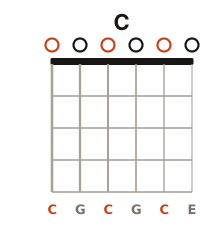
Open strings — C major across five octaves.
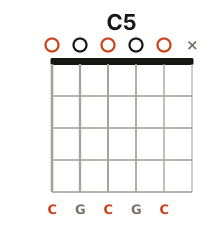
Mute the E and it is a pure C power-chord drone.
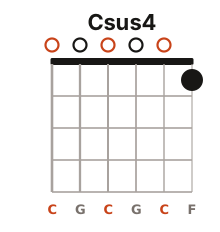
F on the 1st string — the open-tuning "hammer" chord.
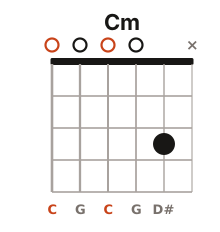
Eb at fret 3 on the 2nd string, high E muted: the whole chord turns minor.
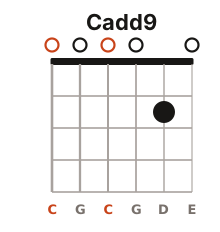
D at fret 2 on the 2nd string for Cadd9.
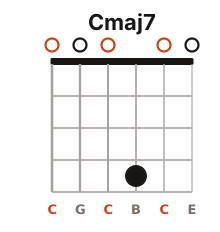
B at fret 4 on the 3rd string.
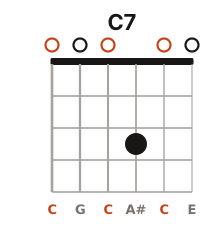
Bb at fret 3 on the 3rd string for a dominant 7th.
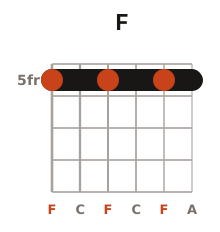
Straight barre at fret 5 — the IV chord.
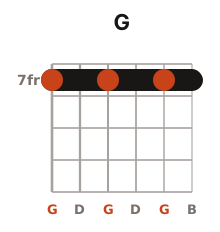
Straight barre at fret 7 — the V chord.
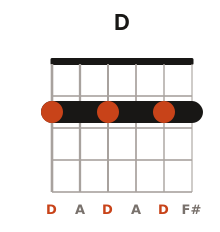
Barre at fret 2.
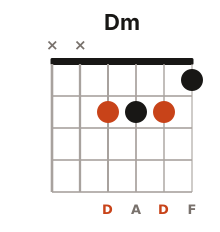
A four-string minor shape: barre at 2, 1st string at 1.
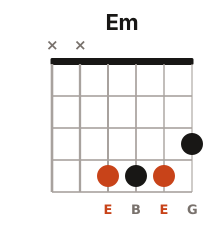
Same shape at fret 4 for E minor.
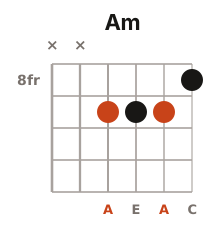
The relative minor, higher on the neck.
Suggested starting point on a 25.5" scale: .012–.056 with a .054–.060 6th string. Run your own gauges through the tension lab before you buy.
Frequently asked questions
What chord is CGCGCE open?▾
A C major chord: C (root), G (fifth), C, G, C and E (the major third). Because the third appears only once, on the top string, Open C is easy to make minor, suspended or a bare power-chord drone with one finger.
What string gauge do I need for Open C?▾
The low C is the issue: use at least a .054 6th string, and .056–.060 if you play hard or use a short-scale guitar. A full set around .012–.056 is typical. The tension calculator on this site can auto-balance a set for Open C.
Is Open C the same as Devin Townsend's tuning?▾
Devin Townsend uses Open C (CGCGCE) on most of his six-string work, often with heavy gauge strings. Other "open C" variants exist — CGCGCE with a high E is the standard one, while CACGCE (Led Zeppelin's "Friends") is Open C6.
Can I play scales in Open C?▾
Yes, but standard-tuning box patterns do not transfer. Use the Scales & Arpeggios tab above: it maps any scale onto CGCGCE and shows position boxes and 3-notes-per-string runs for this tuning specifically.
Related tools & tunings
Found a mistake or want a tuning covered? Leave a note on Ko-fi. Last updated 2026-10-28.