Hendrix · SRV · Guns N' Roses · Alice in Chains
Half Step Down Tuning (Eb Standard) — Chords & Fretboard
The fretboard is tuned a half step down: Eb–Ab–Db–Gb–Bb–Eb. All your standard shapes work unchanged — they just sound a semitone lower — so the chord finder below shows what each shape is actually called in Eb. Read on for why so many bands use it and what it does to your strings.
- Eb–Ab–Db–Gb–Bb–Eb
- All standard shapes work
- Sounds a semitone lower
- ~11% less string tension
Fretboard & chord finder
Pick a tuning and key, click any fret to hear it, and see every scale tone and chord degree across the neck.
Scale & Arpeggio Neck Boxes Show / Hide ▾
Chord voicings
Every playable voicing of each chord in the current key, ranked V1–Vn up the neck. Filter by difficulty or chord type, and use ← → on a card to step through its voicings.
Progression looper & tab
Queue chords, choose a picking pattern and meter, loop it, then export tab, MIDI or a printable chord sheet.
String tension calculator
Total: 103.8 lbs • Avg: 17.3 lbs • All Strings Safe (Balanced) • Custom .010–.046
| Str | Pitch | Scale | Gauge | Tension | Status |
|---|
Guitar tuner
Tune with your microphone to any preset or custom tuning, or tap a string to hear its reference pitch.
Odd-time drum machine
Program custom odd-meter drum grooves in 4/4, 5/4, 6/8, 7/8, 9/8, or 11/8, or enable Sync with Chord Looper so the kit plays behind your chord progressions.
Chord identifier & capo transposer
Tap frets on the neck below or type any 6-string fret grip (like 0-5-3-0-0-0 or X-3-2-0-1-0) to identify every possible chord name, interval formula, and capo equivalent.
Capo & Alternate-Tuning Transposer Equivalents
See how to play this exact concert chord using different capo positions or alternate tunings.
Fretboard & ear trainer
Master note locations across unfamiliar tunings (FACGCE, DAEAC#E, DADGAD, Standard), sharpen interval ear recognition, drill scale degrees, and spell complex chord formulas.
When practicing in alternate tunings such as FACGCE or DAEAC#E, the trainer dynamically recalculates fretboard intervals, open drone strings, and chord voicings so you build genuine muscle memory.
Eb standard tuning explained
Half step down (Eb standard) lowers all six strings by one semitone. Nothing about the fingerboard logic changes: every chord shape, scale box and lick you know works exactly as before, it just sounds a half step lower. Jimi Hendrix played in it, Stevie Ray Vaughan used it with .013 strings, and it is the default for Guns N' Roses, Alice in Chains, Slayer, Weezer, Green Day, Kiss and a long list of hard-rock and punk bands.
There are three reasons to use it. Vocals: songs sit a semitone lower, which is often the difference between a comfortable and a strained chorus. Feel: tension drops about 11%, so a .010 set feels like .009s — bends are easier (which is partly why SRV could use .013s). Tone: slightly looser strings and a lower fundamental sound fatter, especially on humbuckers.
How to tune a half step down
- Set your tuner to chromatic and lower each string one semitone: E → Eb, A → Ab, D → Db, G → Gb, B → Bb, E → Eb.
- Or fret every string at the 1st fret and tune the open strings down until the fretted notes match standard pitch (a reference track or the tuner with the Eb preset).
- Re-check the first strings you tuned; lowering all six relaxes the neck and the earlier strings go slightly flat.
Players who stay in Eb permanently usually go one gauge heavier (.010s → .011s, or .011s → .012s) to restore standard feel. Check your current set in the tension calculator and choose Eb standard to see the exact difference.
Essential Eb standard chord shapes
⬇ Printable Eb standard chord chart (PDF)Diagrams show strings low to high (6 → 1, left to right). × = don't play that string, ○ = open string, orange = the root note. Every shape was checked note-by-note against the tuning. Press Play to load it on the fretboard above and hear it.
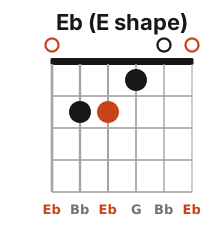
The open E shape now sounds Eb major.
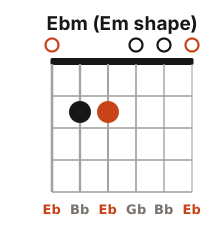
Open Em shape → Eb minor.
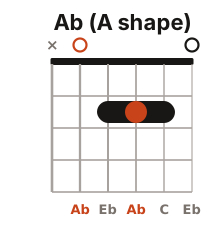
Open A shape → Ab major.
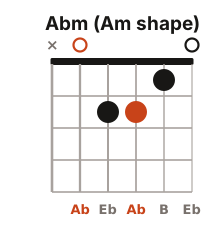
Open Am shape → Ab minor.
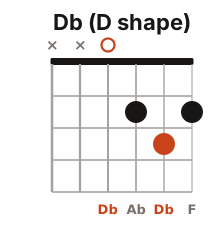
Open D shape → Db major.
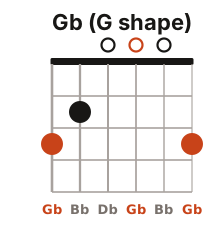
Open G shape → Gb major.
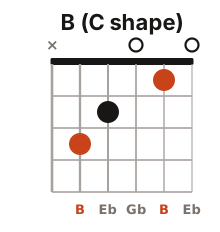
Open C shape → B major.
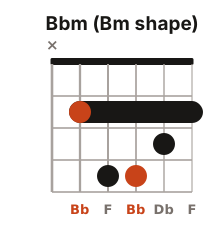
Bm barre shape → Bb minor.
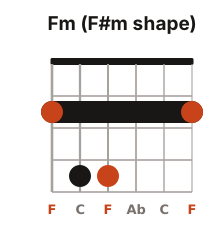
F#m barre at fret 2 → F minor.
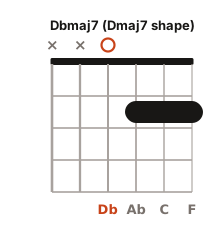
Dmaj7 shape → Dbmaj7.
Suggested starting point on a 25.5" scale: .010–.046 (feels like .009s) or .011–.049 to restore standard feel. Run your own gauges through the tension lab before you buy.
Frequently asked questions
Does half step down change chord shapes?▾
No. Every shape is identical; only the name of the resulting chord changes (an open E shape sounds Eb). If you play along with a recording in Eb, just tune down and use the normal shapes. The fretboard above labels notes and chords with their real Eb-tuning names.
Why did Hendrix tune down a half step?▾
Mostly for vocals and feel. A semitone lower put songs in a better range for his voice, and the reduced tension made his wide bends and whammy work easier on the .010-ish sets he used. SRV took the same idea further with .013 strings in Eb.
Do I need different strings for Eb tuning?▾
Not required — tension drops about 11%, which many players like. If it feels too loose, go up one gauge (.010 → .011). The tension calculator on this site shows the per-string numbers for your scale length.
How is Eb standard different from Drop D or D standard?▾
Eb standard lowers all six strings one semitone and keeps standard intervals. D standard lowers all six a whole step. Drop D lowers only the 6th string a whole step. Drop Db (Drop C#) is Eb standard with the 6th string dropped a further whole step.
Related tools & tunings
Found a mistake or want a tuning covered? Leave a note on Ko-fi. Last updated 2026-10-28.