Rolling Stones · Delta blues · slide
Open G Tuning Chords & Fretboard (DGDGBD)
The fretboard is in Open G. Strings 5–1 are a G major chord, so the famous Stones moves — a barre plus two fingers for the "sus4 hammer" — are a couple of frets apart. Pick any chord below for playable voicings, then read the shapes, slide positions and tuning steps.
- D–G–D–G–B–D
- Open strings = G major
- Keith Richards' tuning
- Three strings down a whole step
Fretboard & chord finder
Pick a tuning and key, click any fret to hear it, and see every scale tone and chord degree across the neck.
Scale & Arpeggio Neck Boxes Show / Hide ▾
Chord voicings
Every playable voicing of each chord in the current key, ranked V1–Vn up the neck. Filter by difficulty or chord type, and use ← → on a card to step through its voicings.
Progression looper & tab
Queue chords, choose a picking pattern and meter, loop it, then export tab, MIDI or a printable chord sheet.
String tension calculator
Total: 103.8 lbs • Avg: 17.3 lbs • All Strings Safe (Balanced) • Custom .010–.046
| Str | Pitch | Scale | Gauge | Tension | Status |
|---|
Guitar tuner
Tune with your microphone to any preset or custom tuning, or tap a string to hear its reference pitch.
Odd-time drum machine
Program custom odd-meter drum grooves in 4/4, 5/4, 6/8, 7/8, 9/8, or 11/8, or enable Sync with Chord Looper so the kit plays behind your chord progressions.
Chord identifier & capo transposer
Tap frets on the neck below or type any 6-string fret grip (like 0-5-3-0-0-0 or X-3-2-0-1-0) to identify every possible chord name, interval formula, and capo equivalent.
Capo & Alternate-Tuning Transposer Equivalents
See how to play this exact concert chord using different capo positions or alternate tunings.
Fretboard & ear trainer
Master note locations across unfamiliar tunings (FACGCE, DAEAC#E, DADGAD, Standard), sharpen interval ear recognition, drill scale degrees, and spell complex chord formulas.
When practicing in alternate tunings such as FACGCE or DAEAC#E, the trainer dynamically recalculates fretboard intervals, open drone strings, and chord voicings so you build genuine muscle memory.
Open G tuning explained
Open G — D–G–D–G–B–D — is the tuning of "Brown Sugar", "Start Me Up", "Honky Tonk Women" and most of Keith Richards' riffs, and before that of Robert Johnson, Son House and generations of Delta slide players. Strings 5 to 1 spell G major; the 6th string is a low D (the fifth), which Richards famously removes altogether to play five-string guitars where the lowest note is always the root.
The signature rock move is simple: barre a fret with the index finger and add the ring and little fingers two frets up on the 4th and 2nd strings — that turns the major chord into a sus4/add4 "hammer" and back. On the open strings that is G → Gsus4 (X-0-0-0-1-0); at fret 5 it is C → Csus4. For slide, straight bars give G (0), C (5), D (7), F (10) and G again at 12.
How to tune to Open G from standard
- 6th string: E → D (down a whole step).
- 5th string: A → G (down a whole step).
- 4th, 3rd, 2nd strings: D, G, B — unchanged.
- 1st string: E → D (down a whole step).
Every change goes down, so any standard set works. For a Stones-style five-string setup, simply leave the 6th string off (or mute it). Slide players tend toward .011–.052 or heavier with raised action. See the tension calculator to compare.
Essential DGDGBD chord shapes
⬇ Printable DGDGBD chord chart (PDF)Diagrams show strings low to high (6 → 1, left to right). × = don't play that string, ○ = open string, orange = the root note. Every shape was checked note-by-note against the tuning. Press Play to load it on the fretboard above and hear it.
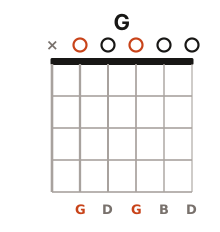
Strings 5–1 open: G major. Mute or skip the low D.
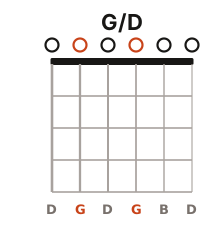
All six strings — G major with the fifth in the bass.
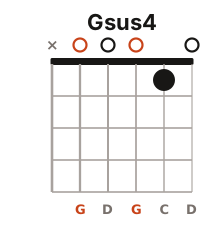
The Keith Richards "hammer": C at fret 1 on the 2nd string.
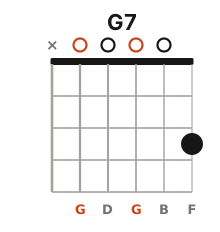
F on the 1st string for a dominant 7th.
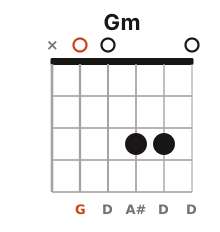
Bb on the 3rd and 2nd strings turns the chord minor.
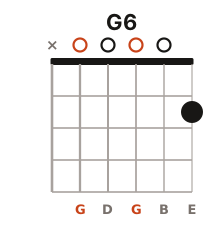
E on the 1st string — a country-flavoured G6.
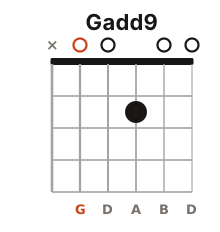
A on the 3rd string for Gadd9.
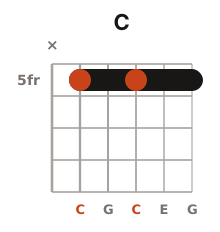
Barre at fret 5 — the IV chord (slide position).
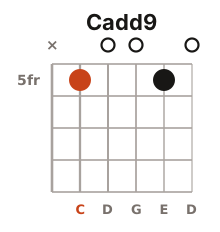
Cadd9 with open strings ringing inside the barre position.
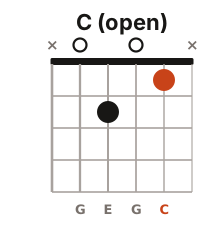
A first-position C major with no barre.
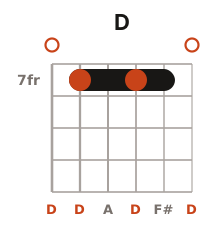
The V chord at fret 7 with open low and high D strings.
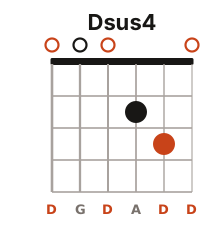
Open-position suspension over the low D that resolves to G.
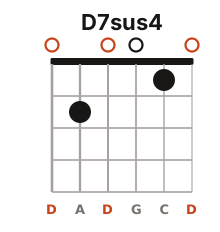
Add the C at fret 1 on the 2nd string for the dominant 7th suspension.
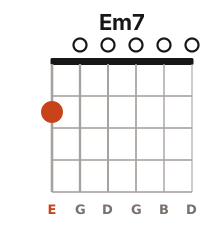
One finger at fret 2 on the 6th string: the relative minor.
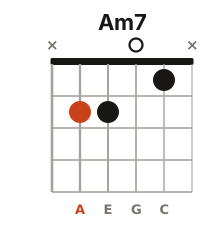
The ii chord, compact and open.
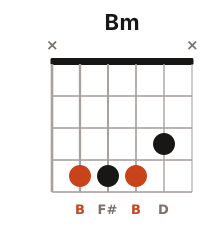
The iii chord as a four-string shape.
Suggested starting point on a 25.5" scale: .010–.046 electric / .012–.053 acoustic; heavier for slide. Run your own gauges through the tension lab before you buy.
Frequently asked questions
Why does Keith Richards remove the 6th string in Open G?▾
In Open G the 6th string is a D — the fifth of the chord — below the G root. Removing it means the lowest string is always the root of any barre chord, which keeps riffs like "Start Me Up" tight and lets the thumb hang over the neck without muting. It is a preference, not a requirement.
What is the difference between Open G and CGDGBD?▾
CGDGBD lowers the 6th string a further whole step to C. All shapes on strings 5–1 are the same; the low C gives a IV-chord root under the open G. See the CGDGBD page for that variant.
Which songs use Open G?▾
"Brown Sugar", "Start Me Up", "Honky Tonk Women", "Tumbling Dice" (Rolling Stones); "Walking Blues" and "Crossroad Blues" (Robert Johnson, often with a capo); "Death Letter" (Son House); "Fearless" (Pink Floyd); and much of the Black Crowes catalogue.
Do I need special strings for Open G?▾
No — three strings go down a whole step, so a standard set is fine. Heavier strings help slide tone and keep the low D from flapping; the tension calculator shows exactly how much each string relaxes.
Related tools & tunings
Found a mistake or want a tuning covered? Leave a note on Ko-fi. Last updated 2026-10-28.